Find Me At Screen Rant

Friday, October 28, 2016

Inferno

INFERNO

** SPOILERS **

Robert Langdon wakes up in a hospital bed in Florence, Italy, befuddled, feeling like he got shot in the head. Buddy, I know that feeling. I sat through Inferno. The third in the Robert Langdon series based upon the Dan Brown novels, directed by Ron Howard, and starring Tom Hanks, Inferno literally puts the fate of the world in Langdon's hands. This time, there's a pathogen on the loose, created by crazy billionaire Ben Foster. Now, Foster may have a point that the world is dangerously on the brink of global over-population, but despite his obsession with (misquoting) Dante Alighieri, Foster seems like he's read too many Marvel Comics. Foster's pathogen, the Inferno (which, mind you, comes in a plastic bag), is designed to wipe out half the world's population in a matter of days. Hey, killing half the population is Thanos' thing. Ben Foster was a middling Angel in X-Men; he's sure as hell no Thanos.

Langdon is lured into this crazy, Dante Alighieri-based mystery puzzle plot by multiple forces who all seem 1) eager to shoot him and 2) eager to ask for his help, in that order. There's the World Health Organization, repped by Westworld's Sidse Babett Knudson, who used to be Langdon's sorta girlfriend. Then there's a shadowy "security" organization run by Irrfan Khan, last seen piloting a helicopter into a bunch of pterodactyls in Jurassic World. There are also two dangerous, gun-toting agents of mysteriously foreign origin and questionable allegiances, Omar Sy and Ana Ularu. Last but not least, there's Felicity Jones, the British emergency room doctor who saved Langdon when he was kidnapped and shot in the head. Jones is conveniently a "big fan" of Langdon and of "puzzles." She claims she met Langdon when she was nine years old, and for some reason she's gung ho about finding a killer virus. Something seems fishy about that, but Langdon, wobbly and confused for half the movie from his injuries, doesn't have the wherewithal to suss this stuff out this time. Langdon suffers from a unique affliction in Inferno: Half the Movie Amnesia, which he's conveniently cured of just in time to put all the clues together and foil the end of the world.

By now, we're wise to all this Dan Brown twisty mystery plotting based on academic research into history and antiquity. Inferno is as rote and mechanical as this hokum gets. Neither Howard nor Hanks seem remotely interested in the hoops Langdon must jump through to solve the puzzles in Inferno. Hanks zips through the exposition while suppressing yawns, and who can blame him? Compared to the "secret history" of the Knights Templar, Jesus Christ, Mary Magdalene, and the Holy Grail, there's none of the inherent juiciness in the history of Dante Aligheri that gave The Da Vinci Code what little pulpy fun it had. Nor does Inferno have the benefit of a scenery-chewing Sir Ian McKellan livening these dreary proceedings. Inferno whisks Hanks, Jones, et al to smashing locales like Florence, Venice, and Istanbul, but no one in the movie has the slightest bit of fun. Hanks and Jones seem perfectly resigned to being a mystery-solving duo completely absent of chemistry. Hanks contorts his face for the entire movie into his version of Dante Aligheri's Death Mask, and Jones sports an I'm Just Here for a Paycheck/Fuck This, I'm In Star Wars Now face throughout the entire movie. Inferno is super duper serious all the time, even when the survival of half the human race depends on Hanks winning a three way fist fight in three feet of water for a plastic bag of pathogen.

Monday, October 24, 2016

Jack Reacher: Never Go Back

JACK REACHER: NEVER GO BACK

** SPOILERS **

"Congrats, Jack. I don't give a shit." says the heavy to Jack Reacher before their climactic rooftop fistfight, and we're inclined to agree. In Jack Reacher: Never Go Back, Tom Cruise returns as the titular character, a mysterious former Army Major turned drifter who rights wrongs with clinched fists and jaw. This time, Reacher, who made his way to Washington, D.C. for what he hoped to be a booty call with his replacement in command of his unit, Major Cobie Smulders, finds himself embroiled in a conspiracy within the Army to frame Smulders for the deaths of two of her soldiers in Afghanistan. Somehow, this involves a shadowy network of arms dealers, and even more somehow, it places a teenage girl who may or may not be Reacher's daughter played by Danika Yarosh in harm's way. Suddenly, tough guy loner Jack Reacher ends up on the run with an ersatz family and may have been a deadbeat dad all along. He looks as happy about it as we are.

The previous Jack Reacher film written and directed by Christopher McQuarrie was a solid thriller that established Reacher as the smartest bad ass in any room. In Never Go Back, Edward Zwick, who took over the helm and co-wrote the screenplay, does away with most of Reacher's vaunted brain power. Reacher retains the uncanny ability to spot evil mercenaries tailing him, but that's about all he can do anymore. Reacher spends the whole movie puzzling out the conspiracy against Smulders, and that's nothing compared to the mystery of whether Yarosh really is his daughter, which he never does suss out until Yarosh literally spells it out for him. The previous film also established that Reacher was irresistible to women, but Never Go Back does a total 180 on that. Boy, is Reacher now a dick - rude, sexist, and unappealing - which half the women in the movie including Smulders are at pains to point out. Reacher's a total Jackoff in Never Go Back.

Cruise, who produced Never Go Back, seems inexplicably hellbent on subverting audience expectations of what a Tom Cruise movie is. Cruise spends 99% of Never Go Back willfully suppressing his patented Tom Cruise charm, his face frozen in a scowl throughout the entire movie as if he's wearing an Angry Tom Cruise version of those masks everyone dons in his Mission: Impossible films. Who ever thought Tom Cruise would hold Tom Cruise's smile hostage, and why? In place of charms or brains or a plot audiences can follow and invest in, Never Go Back substitutes running. See Reacher run. Run, Reacher, run. Never Go Back makes Cruise and whomever is with him, usually Smulders, run enough to equal the running in any three prior Tom Cruise movies. Cruise and Smulders seemingly spent their rehearsal time practicing endless wind sprints, rather than creating a believable romantic chemistry. Never Go Back also sets the record for the number of cell phones slipped into characters' pockets in a movie. As you leave the theater, you'll be sure to check your own pockets to see if someone slipped you a burner phone, as you silently promise to never go back if Jack Reacher returns for a threepeat.

Monday, October 17, 2016

The Accountant

THE ACCOUNTANT

** SPOILERS **

Ben Affleck is The Accountant. Affleck stars as "Christian Wolff," one of many nom de plumes his character adopts, based on the names of history's greatest mathematicians. Now, Affleck is no mere accountant, oh no. He also 1) suffers from a high-functioning form of autism since childhood that renders him socially repressed but one of the most gifted mathematicians on the planet, 2) is a freelance book keeper for some of the world's most dangerous criminal organizations, and 3) happens to be one of the world's greatest assassins, a regular Jason Bourne with (Good) Will Hunting's head for numbers. Like the taxes Affleck does for a kindly Illinois farm couple who are also his clients, The Accountant's books are quite overcooked.

The Accountant's screenplay by Bill Dubuque seems to have escaped the writer's workshop too soon. Affleck's story alone is a convoluted rigamarole: His ruthless Army Colonel father drove his hapless mother away when he refused to let young Affleck attend a special New Hampshire school to treat his autism. Instead, the Colonel dragged Affleck and his brother around the world 37 times, forcing them to endure brutal schooling in the martial arts and egging them on to have street brawls with their Parisian school chums. As an adult, Affleck received expert tutelage in criminal accounting by George Bluth himself, Jeffrey Tambor, his callow prison roommate. 

Affleck then went to work for a mysterious British lady who instructs him over the phone, as if he were her only Charlie's Angel. Affleck cooks the books for international crime lords when he isn't also killing people or posing as an actual CPA in the suburbs of Chicago. And that's all before he starts doing the accounting for a robotics corporation owned by John Lithgow. Affleck is there to investigate missing millions of dollars found by a junior level accountant played by Anna Kendrick. Of course, Affleck falls for Kendrick, the only math nerd who can understand his extreme math nerdiness. Kendrick is an out of place distraction in The Accountant, a sore thumb when counting with our fingers. And doubly of course, Affleck ends up in the middle of a murder plot where killers lead by Jon Bernthal start offing Lithgow's partners, placing him directly at gruesome odds with this gang of murderous thugs.

If that all that weren't enough, Affleck is being investigated by the United States Treasury run by J.K. Simmons, who recruits Cynthia Addai-Robinson, a former criminal who lied about her past to become an analyst in the treasury. Together, they track down this mysterious Accountant, before Simmons suddenly launches into a complicated third act exposition monologue revealing his entire career was linked to Affleck, they met in the past, and Affleck's British lady boss not only has Simmons in her thrall, but now Addai-Robinson as well. And all that's before the question of whatever happened to young Affleck's brother is answered with the bloody obvious reveal that Bernthal is Affleck's brother all grown up. Director Gavin O'Connor, who helmed the superior MMA brothers-up-in-arms smash Warrior, again goes to the well of two brothers slugging it out before admitting they love each other. The only thing The Accountant didn't account for was why Affleck rubbed and beat his shin bones with a pole whenever he's upset.

It turns out the biggest accounting job in The Accountant is keeping track of all of the DC, Marvel, and other nerdy comics references and casting choices. Let's show our work: Obviously, Affleck is currently Batman. His brother Bernthal is Marvel and Netflix's The Punisher. (As Affleck was also once Daredevil, Bernthal has now fought two Daredevils in the movies and on Netflix.) Simmons is the new Commissioner Gordon opposite Affleck's Batman. Addai-Robinson played Amanda Waller, leader of the Suicide Squad on The CW's Arrow. Amusingly, Affleck, who, again, is Batman, makes a point of packing a vintage copy of Action Comics #1 when he plots to escape with Kendrick. Affleck also quotes the words "statistically speaking," which is a famous line ("Statistically speaking, flying is still the safest way to travel") spoken by two Supermen, Christopher Reeve and Brandon Routh. Bernthal calmed Affleck down as a boy by reciting the rhyme "Solomon Grundy," which is also DC Comics super villain. Affleck and Bernthal's mother isn't named Martha, but Martha does appear at the very end at the autism center in the form of Alison Wright, who played Martha in The Americans. For most of the movie, Affleck does his best impression of stoic Mr. Spock from Star Trek, with the rare giggling like a giddy school boy while showing off his math for Kendrick. The Accountant works overtime crunching numbers but all those numbers just don't add up.

Marveling at Darth Vader

MARVELING AT DARTH VADER

Marvel recently concluded a remarkable 25 issue run of their blockbuster Darth Vader title. A simply incredible achievement by writer Kieron Gillen and artist Salvador Larroca, Darth Vader was the most provocative, enlightening, and inspiring of Marvel's line of officially canon Star Wars comics. 

Set immediately after the destruction of the Death Star in Star Wars: Episode IV - A New Hope, Darth Vader thrillingly depicted the Dark Lord of the Sith's attempts to prove himself once more to the Emperor, who blamed him for the failure of the loss of the Death Star. 

Gillen and Larroca gifted Vader with his own unforgettable supporting cast, including droids Triple-Zero and BeeTee One, hilariously homicidal versions of See Threepio and Artoo Deetoo, and best of all, the rogue archaeologist and droid technician Dr. Aphra, a twisted female version of Indiana Jones and the best new female character in the Star Wars canon (sorry, Rey). Vader also faced off against villainous challengers to his supremacy, including cybereticist Dr. Cylo and his cadre of creations, all of whom sought -- and failed -- to supplant Vader as the Emperor's apprentice.

Throughout their 25 issues and Darth Vader Annual #1, Gillen, Larroca, et al delivered a cinematic experience that truly felt like Star Wars at its best, depicting Vader as a calculating, fearsome, and indomitable force, while never compromising his terrifying mystique. Indeed, Darth Vader even gloriously enhanced Vader's mystique, allowing him to perform breathtaking acts using the Force even the movies never did. What's more, Gillen and Larroca sparingly but brilliantly used flashbacks to Vader's former life as Anakin Skywalker, allowing us to delve into his deepest regrets and his torment over his loss of Padme Amidala, which stoked the fires of his obsession to find Luke Skywalker, his newly discovered son.

The following are my favorite moments from Darth Vader, the Star Wars comic that truly proved nothing is impossible for the Force:

VADER SLAUGHTERS TUSKEN RAIDERS (AGAIN) 

When Anakin Skywalker slaughtered the Tusken Raiders who kidnapped and killed his mother Shmi in Star Wars: Episode II - Attack of the Clones, he never set foot on Tattooine again. Anakin did not, but we learn in the comics Darth Vader came to Tattooine. His business was with Jabba the Hutt, where we learn in a retcon that Vader walked a path into Jabba's throne room that his son Luke Skywalker would unwittingly follow in Star Wars: Episode VI - Return of the Jedi. Vader's other business on Tattooine was to recruit bounty hunters, including Boba Fett, to find Luke Skywalker, but at this point in the story, Vader had yet to learn the name of the young rebel who destroyed the Death Star. While waiting to meet with the bounty hunters, Vader busied himself with an old habit and slaughtered even more Tusken Raiders. (Later, we learn in a coda to the entire Darth Vader series, the Tusken Raiders created a myth about Vader, worshiping him as a vengeful god.)

RAIDERS OF THE LOST TRIPLE ZERO MATRIX

Our introduction to rogue archaeologst Doctor Aphra is delightfully familiar to everyone who loves Raiders of the Lost Ark. Aphra, Star Wars' villainous answer to Indiana Jones, successfully obtained the lost Triple Zero matrix, a relic of the Old Republic, which she programmed into the homicidal protocol droid Triple Zero. Of course, to get the matrix, Aphra had to escape deadly traps that were clever homages to Indiana Jones by the skin of her teeth, only to fall under the thrall of Darth Vader, her new "boss" whom she cheerfully aided, abetted, and betrayed throughout the series. The strange relationship between Vader and Aphra, where she loyally serves him out of the fear that he would murder her the second he no longer found her useful, was the oddly touching and compelling heart of Darth Vader. Doctor Aphra proved to be so charming, and popular, we have been gifted by an ongoing Doctor Aphra comic series by Marvel written by Gillen. Still, with Aphra now believed dead and hiding from Vader, we'll miss their unique exchanges. We've never seen anyone talk to Lord Vader this way before or since:


VADER V RANCOR

Once more, Luke Skywalker would be surprised to learn that a lot of stuff he famously did, his father did first, and better. That includes fighting a rancor. In this case, Vader faced a rancor cybernetically enhanced by Tulon Voidgazer, a brilliant, evil scientist and one of the would-be heir apparents to Vader. The cyberanimate rancor Vader battled had its pain receptors eliminated technologically. So, when the usual Force Chokes and Jedi/Sith tactic of amputating limbs by lightsaber didn't work, Vader brilliantly used the Force to hurl his lightsaber into the rancor's head, disabling the cybernetics. The rest was all too easy for the Dark Lord of the Sith, who finished the rancor off with the ol' lightsaber stab to the brain. 

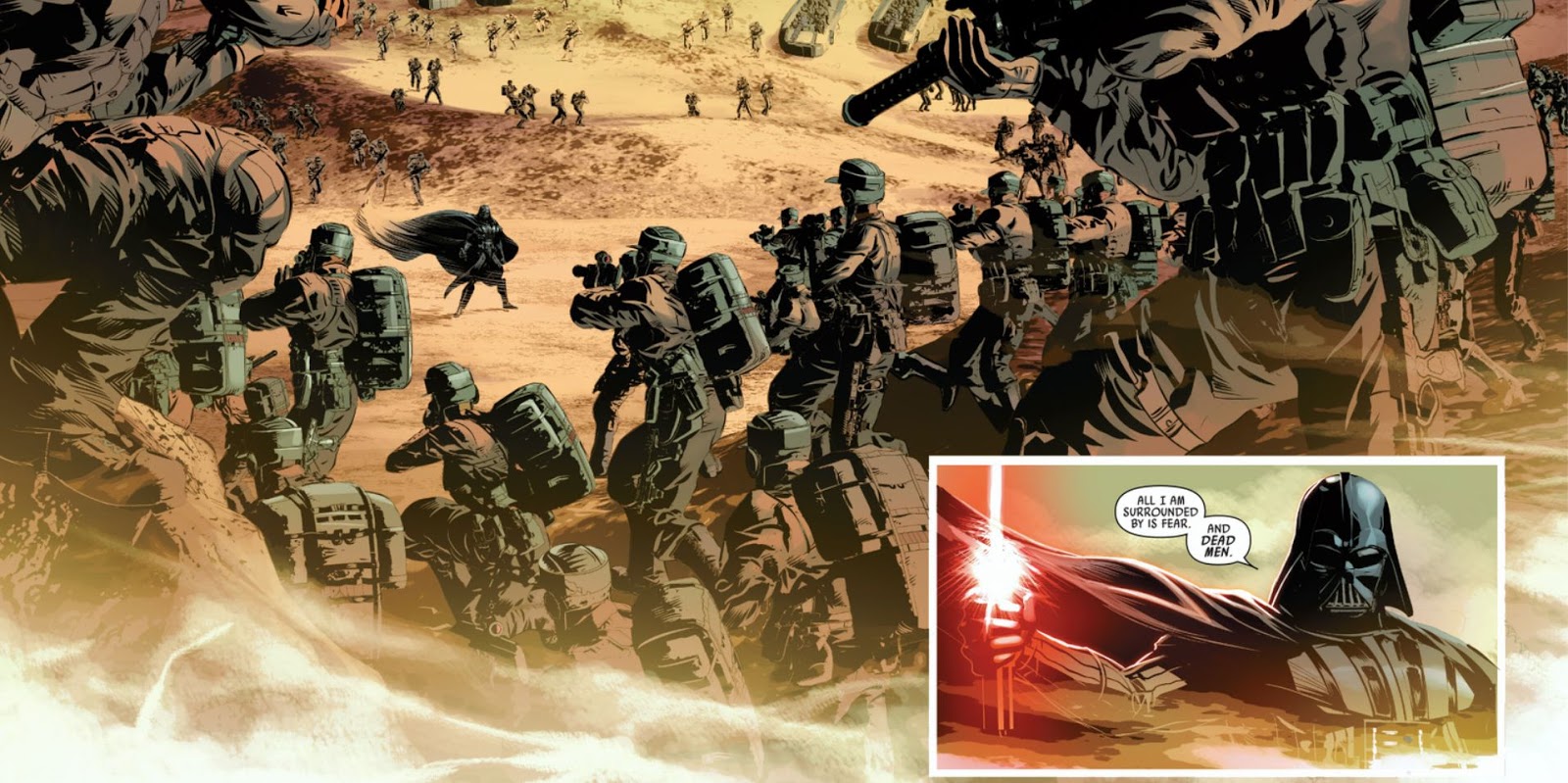
VADER DOWN, BUT NEVER OUT

"All I am surrounded by is fear. And dead men." These were the chilling words Darth Vader uttered when surrounded by the collective force of the Rebel Alliance in the Vader Down crossover series. And Vader was right; it was the Rebellion that was in deep poo doo here. Tracking Luke Skywalker to a lost Jedi Temple on Vrogas Vas, Vader, alone, destroyed three squadrons of X-Wing Fighters before Luke Skywalker himself collided his X-Wing with Vader's TIE-Fighter, shooting the Dark Lord down. The Rebels then amassed in full force to kill Vader and... it didn't go so well for the Rebels, who were nearly all annihilated. Never has Vader's bad assery been on such thorough display. Vader Down also features hilarious confrontations between Vader's allies Dr. Aphra, BT-1, Triple Zero, and Wookiee bounty hunter Black Krrsantan vs. Luke Skywalker, Han Solo, Princess Leia, Chewbacca, C3P-0, and R2-D2, where we finally got to see Aphra fight Solo (whom she'd never heard of), and Chewbacca tear off Triple Zero's arm and beat him with it. Oh, and Vader battled another of Dr. Cylo's would be replacements for him, Karbin, a Mon Calamari trapped in the quadruple lightsaber-wielding cyborg body of General Grievous. That fight didn't go so well for Karbin.

VADER REBOOTS WITH THE FORCE

In the Darth Vader series' ultimate display of Vader's indomitable will and mastery of the Force, Vader's cybernetic body was deactivated by Dr. Cylo, who was revealed to be the robotics genius who created Vader's armored form. Cylo believed he achieved ultimate victory over Vader by simply shutting him off, but he sorely underestimated the amount of sheer hatred in Vader's heart. In a moving series of Star Wars: Episode III - Revenge of the Sith-inspired flashbacks and dream sequences, Gillen and Larroca depict Vader coping with a "Last Temptation of Anakin Skywalker" scenario, where Vader's memories of Obi-Wan and Padme plead with what's left of Anakin still within Vader, before Vader battles and overwhelms the last vestige of Anakin Skywalker. In the end, empowered by the Dark Side of the Force, Vader wills his cyborg body to reboot and finally executes Dr. Cylo with a lightsaber through the torso. It was an awe-inspiring moment once more proving that for Darth Vader, all is possible through the Force.

These are just a few of my favorite moments from Gillen and Larroca's spectacular Darth Vader run. A run absolutely worth reading in its entirety. Maybe some day, Disney will adapt this series into a Darth Vader feature film. Regardless, Darth Vader never compromised the Dark Lord's villainous machinations, motivations, and deeds. Or as Doctor Aphra correctly surmised:

Saturday, October 8, 2016

The Girl on the Train

THE GIRL ON THE TRAIN

** SPOILERS **

"There are a lot of threads here that seem promising, but they don't amount to much," says Detective Allison Janney to Rebecca Ferguson during her murder investigation. That telling quote aptly sums up The Girl on the Train, director Tate Taylor's blank adaptation of the Paula Hawkins' bestseller, itself an overrated potboiler. Told mostly from the point of view of Emily Blunt, the titlular Girl on the Train and an alcoholic who gazes longingly at the home, husband and life she lost during her daily train commute into New York City, The Girl on a Train is a sober, enervating whodunit with a reveal so obvious and telegraphed, the killer all but twirls a handlebar mustache when he's found out.

In her former life, Blunt was happily married to Justin Theroux, who now lives in their house with his new wife Ferguson and their newborn. They have a nanny, Haley Bennett, who's also a next door neighbor, and Bennett is married to Luke Evans, whom the movie is at pains to describe as an emotionally abusive monster. In her daily drunken reverie, Blunt fantasizes from her train seat about the lives of these seemingly perfect people, until Bennett disappears and is murdered on the same night Blunt disembarked from the train in their neighborhood. She has no memory of why she awoke bloody and beaten the next morning. Who killed Bennett? Was it Evans? Was it her therapist Edgar Ramirez, who succumbed to Bennett's sexual advances during their sessions? Was it Blunt herself? The Girl on the Train awkwardly shifts between these possibilities, toying with what Blunt does and doesn't remember, until she eventually remembers everything, revealing the real killer to the shock of no one paying attention. 

Blunt is convincing as a drunk grasping at straws, a liability to herself and to those around her. We're meant to ultimately find her sympathetic as the story reveals in a bit of a cheat that it turns out nothing she did was actually her fault, except for all the stuff she does that's actually her fault. Ferguson is wasted in a thankless, nothing part of being Theroux's dutiful but suspicious wife, until circumstances way beyond what's acceptable forces her to literally put the screws to Theroux. Wilson and Ramirez alternate as unlikable jerks whose sole redeeming features are they weren't the ones who murdered Bennett. Bennett herself delivers The Girl on the Train's most complex performance, though the movie doesn't really mourn her loss too much, as her real value is being a plot device. Unlike the seemingly similar Gone Girl, The Girl on the Train offers little subtext or biting commentary on marriage or suburban life. As a murder mystery, it's a remedial whodunit, checking off plot points like a train making every stop along its two hour travel time.

Wednesday, September 28, 2016

Teenage Mutant Ninja Turtles: Out of the Shadows

TEENAGE MUTANT NINJA TURTLES: OUT OF THE SHADOWS

** SPOILERS **

Stealth. Cunning. Silence. These are some of the hallmark traits one can associate with ninjas. Traits entirely absent from Teenage Mutant Ninja Turtles: Out of the Shadows, the cacophonous, ludicrous follow up to the successful 2014 reboot. The prior Teenage Mutant Ninja Turtles took pains to establish this world of mutated, talking, pizza eating, humanoid teenage terrapins (proudly) named by the fetching intrepid reporter April O'Neil (Megan Fox) after Italian Renaissance painters: stern leader Leonardo (Pete Plozek), techie-nerd Donatello (Jeremy Howard), hard charging Raphael (Alan Ritchson), and party animal (literally) Michaelangelo (Noel Fisher). Louder and dumber than its predecessor, like a five year old banging dishpans together, Out of the Shadows squarely aims to recreate the weekday cartoon from the 1990s, with wall-to-wall CGI mutant creatures colliding into each other making tons and tons of noise, signifying nothing.

A year after defeating the evil ninja master Shredder (Brian Tee) and his ninja Foot Clan, the Ninja Turtles continue their thankless mission of protecting New York City from evil. But all is not harmonious within the four brothers. The Turtles are divided by their desire, like Ariel the Little Mermaid, to be part of that world above and be accepted. Their chance comes via a purple ooze from another dimension, a gift to Shredder from Commander Krang (Brad Garrett), a talking sludge of Pepto Bismol puke housed in a robot body and the most ridiculous and unsightly CGI creature in a movie bursting at the seams with them. This ooze could turn the Turtles into humans, an opportunity the Turtles reject after quick, arbitrary soul searching. Shredder and his mad scientist Tyler Perry instead use the ooze to transform a couple of bumbling henchmen Rocksteady (the WWE's Sheamus) and Bebop (Garry Anthony Williams) into a giant mutant rhinoceros and warthog respectively. The Turtles and April O'Neil recruit their own backup: not just April's old cameraman turned preening Hero of the City Will Arnett (who publicly took credit for Shredder's defeat so the Turtles wouldn't be publicly exposed), but also Casey Jones (Stephen Amell), a corrections officer in a goalie mask who fights ninjas with a hockey stick. 

Out of the Shadows unabashedly plays as a live action cartoon toy commercial. New vehicles like the Turtles' Battle van and the Foot Clan's motorcycles are trotted out and all but boxed and placed on Toys R Us shelves. The great threat to New York City is Krang's Technodrome, a massive Death Star-like base that arrives through a ripple in the sky in pieces, which the Ninja Turtles fight to prevent it from fully assembling. Every human, including Laura Linney as a police captain, plays the material as broad as possible, which is to say every performance is terrible. Everyone in Out of the Shadows who's not a mutated animal of some sort is thanklessly wasted by the overwhelming spectacle of CGI dominating the screen every moment. Wasted most of all is Megan Fox, who anchored the first movie with a heroic lead performance, but in this sequel, she's an arbitrary sidekick to the Turtles with no arc of her own, left to just react and reassure all the other humans meeting the Turtles for the first time that they're all right. Out of the Shadows is 112 minutes of being bludgeoned in the face by a bo staff, sai, katana sword, and nunchucks, and then a whole large pepperoni pizza is shoved down your pants.

Friday, September 23, 2016

The Magnificent Seven

THE MAGNIFICENT SEVEN

** SPOILERS **

I Seek Righteousness. But I'll Take Revenge.

The Magnificent Seven reunites the stars and director of Training Day, Denzel Washington, Ethan Hawke, and Antoine Fuqua, in a rootin'-tootin', shoot-em-up remake of The Three Amigos. The Magnfi -- what's that? Yul Brenner? Steve McQueen? There was a previous Magnificent Seven? Wait, what? The Seven Samurai? Akira Kurasawa? Are you sure? Huh. Well, okay. Let's start again.

The Magnificent Seven reunites the stars and director of Training Day, Denzel Washington, Ethan Hawke, and Antoine Fuqua, in a rootin'-tootin', shoot-em-up remake, transplanting all of the action to the Old West mining town of Rose Creek, which is under duress from scheming robber baron Peter Sarsgaard. Sarsgaard plays Bartholomew Bogue, the most evil man in 1873, who rolls into Rose Creek with a private army, takes over the gold mining operation, and threatens to kill everyone in the town if they don't accept his offer of $20 for their plots of land. He burns down their church and makes a bloody example of some of the townsfolk, including Matt Bomer, the husband of Haley Bennett. Looking for revenge, Bennett gathers up "all she has" in gold coins and sets off to hire as many bad ass movie star gunslingers as she can afford. She can thank her stars and garters she found Denzel.

Denzel is excellent as Sam Chisolm, a duly sworn bounty hunter and evidently the fastest gun in the West, who gets real interested when he hears the name Bart Bogue. Denzel and Bennett recruit Chris Pratt, stepping into the Steve McQueen role, as Josh Faraday, a comedic magician cowboy, but deadly. Together, Denzel and Pratt bring in Ethan Hawke as Goodnight Robicheaux, the best shot with a rifle in the Civil War, Vincent D'Onofrio as Jack Horne, a legendary frontiersman, Manuel Garcia-Rulfo as Vasquez, an honorable Mexican bandito, and two guys competing for the coolest minority of the Seven, Byung-hun Lee as knife-wielding Chinese bad ass Billy Rocks, and Martin Sensmeier as heart-eating Comanche killer Red Harvest. The screenplay by True Detective creator Nic Pizzolatto and Richard Wenk, has fun bringing the Magnficent Seven together, landing some ribald jokes as these dastardly guns for hire bounce off each other. Denzel and Hawke wink at their prior collaboration by playing old friends, Pratt goes after Garcia-Rulfo with some off color teasing for being Mexican, but no one is aiming for any particular depth in their characters. The Magnificent Seven plus Bennett and Saarsgard's pure movie star charisma are the nine bullets in Fuqua's chamber.

Once the Magnificent Seven arrive in Rose Creek, our heroes quickly roust Sasgaard's remaining forces from the town in a show of force and spent the seven days until Sarsgaard returns with his army to prepare the townspeople for war. There's some comedy in the ineptitude of some of the towns folk in trying to shoot, but otherwise, the last act of The Magnificent Seven is a straight-forward, ultra violent, melee of gun blazing, men being shot off horses, wild charges blown to smithereens by dynamite, and the most fearsome weapon of the 19th century, a gatling gun, ripping the town and most of the characters to shreds. Denzel and Sarsgaard have a final confrontation that turns out to be very personal, indeed. After saving tween Dakota Fanning in Man on Fire and teen Chloe Grace Moretz in The Equalizer, for once Denzel turns out to need saving by the white girl in his movie. It's a neat twist to see Haley Bennett bail Denzel's ass out of a jam. Not all of the Magnificent Seven make it out of The Magnificent Seven alive, but this able remake on the surface provides enough gun-totin' entertainment  to corral the audience's rooting interest and earn the classic theme music finally playing over the closing credits as we all ride off into the sunset.

Followers