Find Me At Screen Rant

Friday, December 21, 2007

Charlie Wilson's War (***)

CHARLIE WILSON'S WAR
December 21, 2007
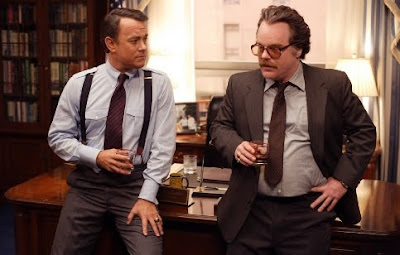
According to Charlie Wilson's War, Charles Wilson, a Congressman from Texas "of no particular importance" finagled a billion dollars of US funds for the CIA to finance Afghanistan's war against the Soviet Union in the late 1980's. Because of Wilson's efforts, the Afghanis had the weapons they needed to become the first nation on Earth to defeat the Soviet Army, which lead to the collapse of the Soviet Union and the end of the Cold War. This is all "based on a true story." Whatever may be true about this story is buried somewhere in a slick, talky, entertaining, 87 minute fluff piece with a lot of snappy patter and virtually no conflict or drama. Seriously, there's no conflict in the entire picture.

In Charlie Wilson's War, Charlie Wilson wins. Every time. Every single problem he faces, he immediately overcomes. Whenever he needs something done, he goes out and does it and nothing impedes him. He makes enemies who meet behind closed doors and complain about him, yet none of them do anything to stop him.

Charlie Wilson always gets exactly what he wants at no cost and with no sacrifice. Charlie Wilson needs to get Israel to work with Pakistan despite their mutual hatred? One meeting and it's done. He needs Egypt to work with Israel? One meeting in a nightclub with a belly dancer he brings in from Texas (!), it's done. He needs his boss Ned Beatty to sign off on giving a billion dollars to the CIA? A trip to Pakistan so Ned Beatty can see the refugees and it's done.

Even when Charlie Wilson isn't personally involved, it's done. According to the movie, the Afghanis had no trouble at all using the US-supplied weapons to destroy the Soviet Army. It was easy as pie. Look, Soviet helicopters and tanks! Just point the rocket launcher and BOOM! It's done. Just like Charlie Wilson taught them. Apparently, waging a clandestine war against the USSR and ending the Cold War was surprisingly easy.

The biggest threat to Charlie Wilson in the movie is a federal indictment pending because he spent a night in a fantasy suite in Las Vegas with a Playboy model, two strippers, a sleazy would-be Hollywood TV producer, and some blow. Not that Charlie Wilson did any lines. The pending indictment causes great consternation to his big boobied harem of assistants, including Amy Adams, Rachel Nichols, and Shiri Appleby, but Charlie Wilson isn't worried. Why should he be? Less than 20 minutes of movie time later, the indictment is dropped and Charlie Wilson skates by another problem that didn't actually pose a problem for him.

I did like Charlie Wilson's style, however. He has excellent taste in big boobied assistants, and even Emily Blunt shows up just to prance around in her underpants and show off her suprisingly hot body. But if I learned anything from the movie, it's that Shiri Appleby needs to be in more movies because she's ridiculously hot.

The engaging dialogue complete with walkandtalks and wink-wink jabs at Washington politics by Aaron Sorkin and the performances by Tom Hanks and Phillip Seymour Hoffman carry the picture. Sorkin sets a record for characters in a movie gleefully talking about how much they love "killing Russians". Hanks musters up all the charisma he has and all the credibility he loaned to the US Government in The Simpsons Movie to give us a very, very likable hero.

Although we're told Charlie Wilson is a drunken, promiscuous rascal (the biggest laugh in the movie is when the murderous President of Pakistan tells Wilson flat out he has character flaws), we never see him do anything wrong. He likes beautiful women and enjoys sex with them. Also, he drinks a lot. Those are his character flaws. Otherwise, he's a prince. Phillip Seymour Hoffman's CIA agent even marvels that Wilson's the "only honest politician" in Washington.

Hoffman does his unkempt, smartest and angriest guy in the room schtick and does it really well. Still, Hoffman might want to get 8 hours of sleep once in a while. Hoffman always looks like he's about to keel over from exhaustion in every movie. Hanks and Hoffman make a good team and there's a hilarious exchange where Hoffman bugged a bottle of scotch he gave Hanks as a present.

Julia Roberts, playing a plastic Southern rich lady version of Tess Ocean, is ostensibly the lead actress because she's Julia Roberts, but Amy Adams has a lot more screen time and is far more endearing as Wilson's number one aide. Since Amy Adams is on her way to becoming the new Julia Roberts, it might be time to retire the original.

All the Oscar talk for Charlie Wilson's War seems like overpraise. It's an entertaining crowd-pleaser but there's not a hell of a lot to it. It seems like all the actual dramatic parts of the story are missing, except for the one dramatic part that made it into the movie: Tom Hanks's bare ass. Thanks, Hanks.

Monday, December 17, 2007

The Simpsons Essay

THE SIMPSONS ESSAY

I love The Simpsons. It's been the major influence on me for as long as it's been on the air and it all but defined my sense of humor and worldview, for better or worse. I tend to be a Simpsons apologist (or justifier as I see it). I know the series is never going to be what it was 10-12 years ago. The Simpsons has been on for almost two whole decades. Along with its natural aging, shows like South Park, Family Guy, Futurama, and live action series like Arrested Development, The Office (run by former Simpsons writer Greg Daniels), My Name Is Earl, etc. have since stolen a lot of their thunder. But when they're on point, The Simpsons can still deliver.

I feel like The Simpsons Movie's long development distracted their best writers and animators over the last few years. It takes six months to create an episode from start to finish. The Simpsons Movie was five years in development and was being re-written and re-edited right up to its release date. The Movie's five year journey to theatres meant at least 5-6 seasons were affected by the series' all-star writers and animators having to split their time between the series and the Movie. I'm curious what the series will be like a year from now with their top talent back on the mothership, if you will.

I've been spending quite a bit of my free time lately watching seasons 4-7 on DVD with commentaries. These were the show's golden years and I'm fascinated by The Simpsons' unique brand of comedy writing. The commentaries are like master classes in writing comedy.

There are definitely aspects of how episodes are put together today (timing, editing, style of jokes) that are different from the golden years. One theory is that the newer writers just aren't as good as the original crop. There's a case to be made for that. However, there are also strange restrictions now placed on them by FOX borne of the current cultural climate that The Simpsons never had to deal with in the mid-90's. (For instance, there is currently a ban on The Simpsons being able to show Homer's (or anyone's) bare ass on the show. The nudity ban is what made them go all out with Bart's full frontal in the Movie. Also, it is now harder/more expensive to do big musical numbers which is why there have been so few in the last few years. On the other hand, they get away with any number of copyright violations -- Count Chocula, The Incredible Hulk Melon Baller that "shits out" melon balls to name two -- these days.)

The showrunner (head writer) for the last few seasons has been Al Jean. The showrunner definitely gets to determine the style of humor the series takes under his stewardship. The most popular years of "Who Shot Mr. Burns?" in the mid-90's were largely run by David Mirkin, who had a style different from Jean's. The episodes speak for themselves. I prefer Mirkin's style and his episodes. I feel Al Jean's run on the series has been more slapdash, although he has modernized the series to a degree (Homer Simpson having a laptop, cell phone, and knowing what YouTube is. The writers ten years ago steered clear of the Simpsons having such amenities so that Homer getting a computer or stealing cable were big deals. Times change, things change.)

The biggest change to me over the last few years has been in Homer Simpson himself. It's really amazing hearing David Mirkin, David Cohen (showrunner of Futurama), Greg Daniels, et al discuss their vision of Homer. To them, Homer "is the most positive guy in the world." No matter how crummy his life is, he's optimistic and happy. He keeps hoping for the best. Watch those seasons and see how loveable their Homer is.

Homer in recent years has veered away from that. He was always a jerk, but in the last few years he has not only acknowledged he's a jerk but takes delight in it. And today's Homer is miserable. He's almost always unhappy and complaining. In the old years, no matter what Homer did, his devotion to Marge and his love for his family was always the elastic that brought him back. Now, Homer regularly dreams of leaving them and even fantasy episodes set in the future have Homer and Marge separated or divorced, unthinkable a decade ago.

It's weird how different the Homer character is. He's still Homer, just with different textures. I personally prefer the older Homer. One of the things I admired in The Simpsons Movie is that they managed to merge all the various aspects of Homer together so the character embodied all of those dimensions in the course of the 90 minutes. I also loved that the Simpsons family unit was the crux of the story, which is rarely the case in the series these days.

Anyway, 2008 will be The Simpsons's 20th season. Imagine that. I'm on board as ever, but I wonder if my theory of The Simpsons Movie finally being in the rearview mirror will cause any noticable changes in the quality of the series.

Saturday, December 15, 2007

I Am Legend: The IMAX Experience (***)

I AM LEGEND: THE IMAX EXPERIENCE

** SPOILERS **

The rightful winner of the Best Supporting Actresss Oscar for 2007 has been found. Her name is Abbey, she's three years old, and she plays Samantha in I Am Legend. That Abbey is a German Shepherd will disqualify her from consideration from those specists in the Academy. Speciesm! I hate speciesm. I don't care who gets nominated for the Oscar this year, Abbey's performance pwns all those other bitches. Show me a better supporting performance by a human actress in a motion picture this year. Even though she'll be robbed of an Oscar she deserves, it won't matter to Abbey. Abbey doesn't care about awards or the Oscars. She's a good girl. Good girl. Have a cookie. Christ, I loved that dog. 

I Am Legend is pretty solid all around. Sometimes terrifying, kind of despressing, exhilirating but not too exhilirating, yet generally effective and satisfying. Unfortunately, the final act isn't nearly as good as what came before it. The movie never quite recovers from the pivotal tragedy that ended the second act. However, there is a palpable feeling of dread that creeps in as things fall apart for Robert Neville, the Last Man on Earth, and it becomes clear he's more screwed than he was before. 

Will Smith was really good. Big Willie delivers one of the best lead performances in a big budget sci-fi action thriller that I've seen in quite a while. It was a bit of a pill to swallow that Will Smith was a brilliant scientist trying desperately to cure the viral infection that turned 90% of the world's population into vampires, but he's a hell of a lot more convincing than some other actors and actresses Hollywood has asked us to buy as brilliant scientists.

Beyond his relationship with his wonderful dog, the best stuff Smith did was convey how the three years alone with his dog in Manhattan drove him insane. His life is an endless series of routine designed to keep himself and his dog alive: wake, exercise, hunt for meat, forage for supplies, broadcast emergency SOS and look for other survivors, back home before dark, set up defenses, try to sleep while 5 million vampires party outside all night. Beyond that, Smith's Robert Neville carries the agonizing guilt of being partly responsible for the virus and for the death of his wife and daughter. Coupled with his loneliness and desperate need for human contact, this is some of Smith's best work. When he traps a vampire female, brings her back to his lab, and tests potential cures on her, it feels like he's not so much trying to be the savior of humanity as he is hoping she'll wake up and provide a dinner companion that doesn't eat off the floor.

Robert Neville's insanity due to his isolation was quite interesting. He goes to video stores during the day and rents DVDs of the Today Show so he can hear human voices and maybe pretend things are the way they used to be. He has conversations and relationships with mannquins he dressed in clothes. When you compare what Neville has to what Tom Hanks had in Castaway, a soccer ball named Wilson, Neville is far better off but still, being the Last Man on Earth is really depressing. I also liked that despite his routine and his precautions, Neville was getting careless. The first time we see him he's chasing deer around Manhattan in his Shelby Mustang and runs head long into a pride of lions escaped from the zoo. Later we see he's staying out later and later, barely making it back to his home by sundown. It was inevitable he'd lose what little he had left by his own behavior and carelessness. It's actually amazing Neville and Sam lasted the three years they did alone in Manhattan surrounded by vampires.

An idea that didn't quite get across as well as it could have was that the vampires were watching Robert Neville and learned from him. The pivotal event of the film begins when one of Neville's mannequins suddenly appears at Grand Central Station and this cracks Neville's fragile psyche. How did "Fred" get there? The movie was a little unclear about it. At first I believed that Neville had simply forgotten he had moved "Fred" and he walked into one of his own vampire traps. I later realized what had actually happened: the "Alpha" vampire that Neville encountered previously saw how his vampire trap worked and set one for him.

The vampires were not well explored in terms of their behavior and whatever "culture" they had. That makes sense since the audience's POV was with Robert Neville. We only see what he sees and know what he knows about them. No one can blame Robert Neville for not descending into the dark vampire hives to do studies on how they spend their days. (The most frightening sequence in the movie is when Sam runs after a deer into a hive warehouse and Neville has to go in after her.) All we know about vampires is that they're hairless, pale, UV light is fatal to them, the CGI used to make them wasn't so great, and they're superfast and superstrong like movie monsters are these days.

Still, there are many questions about the vampires that were left unanswered, especially about what they retained of their human personalities, memory capacity, and identity. The Alpha vampire was more overtly "villainous" than expected by the end. He really seemed to have it out for Neville. Maybe he heard Neville dubbed him and his vampire pals "dark seekers" and thought it was a dumb name. One of the best parts of the novel "I Am Legend" by Richard Matheson was that the vampires knew Robert Neville; the ones who stalked him were once his neighbors and friends. At night, they'd pound on his doors and call his name ("Neville! Come out!") and the female vampires would behave in sexually suggestive ways to entice him to come out. I'd have liked to have seen some of those aspects from the vampires in the movie.

What I really didn't like was A) all that Shrek in the movie (Neville really likes Shrek but I really don't. I've never seen a movie use dialogue from another movie to convey its characters' motivations quite like Legend does Shrek.), and B) Anna the plot device and Ethan, the boy who never talks. The appearance of Anna the plot device right when Neville has lost his best friend and his will to live is right out of the deus ex machina playbook. Anna the plot device doesn't even make any sense: she and Mute Boy somehow survived the vampire apocalypse yet they seem to have stepped out of central casting. They don't look or act like survivors. They have no weapons, no training. Their story was full of holes. They were driving up the East Coast to the last human colony in Vermont and heard Neville's SOS? How the hell did they get onto the island? The flashbacks clearly established all the bridges were destroyed. Assume all the tunnels were as well. Anna is so jarringly out of place and is so clearly a device, it's distracting. We don't care about Anna and her crazy "God told me to drive to Vermont" stories. We don't care about Mute Boy surviving. We care about Robert Neville. We wanted to see Robert Neville set foot in the survivor colony and teach the last humans to get jiggy wit it Big Willie Style. The ending is ultimately a letdown.

If there's one important lession I Am Legend teaches us, however, it's that Emma Thompson will destroy human civilization as we know it. It's all her fault. Somebody stop her before it's too late.

Sunday, December 9, 2007

Atonement (****)

ATONEMENT


Atonement stunningly brings to life England in between the World Wars, and both England and France during World War II. Director Joe Wright palpably recreates a bygone era only some of our grandparents have memory of and fuses it with a dreamy, tragic otherworldliness. Above all, Atonement shows the cost of how one terrible lie can ruin the lives of innocent people.

The details throughout the movie are extraordinary, from the strange singlet swimsuits men wore back then to chocolate bars wrapped in silver paper soldiers carried in their kits to the pneumatic red tubes used to send mail. The production design and costumes are fantastic. Wright uses the percussion beats of an old manual typewriter like the sound of a ticking time bomb and weaves between different point of views of critical scenes to show us how reality differs from what one naive, imaginatively vengeful 13 year old girl perceives.

Atonement's first half immerses us in life in an English country manor, showing the classism between the wealthy owners and their servants, complete with lies, hidden raw eroticism and sexual intrigue. The second half takes place during the war, showing the devastation of France at the hands of the Nazis as well as the cost of the Blitz when the Nazis bombed London, with hordes of wounded British soldiers arriving in the hospitals, met by nurses performing triage. (The grittty authenticity of the war scenes additionally bring to mind what a bullshit cartoon Pearl Harbor was.)

Wright also attempts to match the amazing single unbroken take in Children of Men with his own, showing James McAvoy and his companions arriving on the beach in Dunkirk, the camera sweeping along with and past them across the vast expanse of men and machinery in one amazing unbroken shot.

The cast of McAvoy and Keira Knightley are superb, but for all of Knightley's top billing and Oscar hype, I was most impressed by the two actresses who played Briony Tallis: Saorise Ronan, Briony age 13, and Romola Garai, Briony age 18. Both actresses shared the same mannerisms to convincingly portray the same character five years apart. Ronan's combination of a young girl's naivety and vindictiveness is beautifully matched by the older Garai's silent regret and intention to sacrifice herself to make amends.

The finest scenes in the movie for me are when Garai's Briony attempts to comfort a fallen soldier with the worst headwound imaginable, and the scene where Garai confronts Knightley and McAvoy and attempts to atone for the lie she told that ruined their lives. Both are incredibly staged and performed. Then Atonement gut-punches the audience when Vanessa Redgrave shows up as terminally ill Briony in her 70's and finally tells the whole truth once and for all.

As relentlessly tragic as Atonement is, it's better than something like Babel in that the characters are aware of the tragic turn in their lives and spend the entire movie fighting against fate to restore the happiness they know in their hearts they deserve. McAvoy and Knightley are torn apart by the lie her sister told yet never give up on each other or the dream that they can get back the time stolen from them. Garai is just as tragic as she lives with the guilt of what she did and the cowardice in her heart for her entire life.

Haunting, hypnotic, moving, classy, and ultimately, inevitably crushing, Atonement is one of the best movies I've seen this year.

Wednesday, November 21, 2007

Blade Runner: The Final Cut (****)

BLADE RUNNER: THE FINAL CUT
 
"I've seen things you people wouldn't believe."

Seeing Blade Runner as a boy was like witnessing a fortune telling of my future. I knew when I first laid eyes on Rick Deckard, the laconic blade runner who hunts Replicants in dystopian Los Angeles circa 2019, I'd end up just like him in three specific ways. First, I would have a short haircut. (I actually had a variation of Harrison Ford's Caesar haircut for a while in the '90s.) Second, I would still be single in my 30's. (Kudos to me for keeping that dream alive.) Third and most importantly, like Deckard, I'd be willing to have sex with a robot. (If she looked like Sean Young, although I'm sure when they're eventually invented, fembots will be much hotter.)

The 1992 Director's Cut of Blade Runner has always been the definitive version for me. I've watched it at least a dozen times over the last 15 years. I've also seen the theatrical cut on video with the voice over and more upbeat ending. The harsher, colder, more impenetrable Director's Cut, even with its unicorn dream that Sir Ridley Scott thinks supposedly "proves" Deckard is a Replicant, resonates with me much more.

Deckard has never been a hero by any measure a traditional hero is defined. He shoots a Replicant in the back. He coldly and cruelly reveals to Rachael that all of her memories are implanted from Tyrell's niece, which means she's a Replicant. He then calls Rachael while he's on a case and asks her out even after the way he treated her. Worst of all is their "love scene", where he becomes alarmingly violent both physically and emotionally as he forces himself on Rachael.

The "love scene" is an example of just how vital the score by Vangelis is. Vangelis' haunting music may be the single most important component of Blade Runner. Without the score laid over the "love scene", for example, it would play much, much differently. You can replace the word "love" with "robot rape".

Personally, I still don't believe Deckard is a Replicant. It just doesn't make sense from what we're shown of him and how his few associates behave towards him in the movie. The arguments towards him being a Replicant -- Unicorn! He has red eyes in one shot! More unicorns! -- don't wash with me. Deckard being human -- in some ways being more cruel and dangerous than the robots he hunts -- is the way I prefer to view his character. It makes for a better, more resonant story than "Deckard was a robot all along!" Sir Ridley can insert all the unicorns he wants into his movie, but I'll never buy Rick Deckard is a robot. But the beauty of Blade Runner is that it's ambiguous enough for either interpretation.

After years of blundering about with the rights to the film, the 20th anniversary restoration of Blade Runner in 2002 was completely blown, but here now for the 25th anniversary is the Final Cut, which Sir Ridley promises is the definitive Blade Runner. Having finally seen the Final Cut, it really ain't all that different from the Director's Cut. It actually is just the Director's Cut with a few added shots here and there and some altered or added dialogue noticable only to nerds who know the lines by heart. (That'd be me.)

Here's what I noticed as new or different:

* Bryant giving a bit more information about Leon to Deckard.
* A couple of added shots of the spinner in the air as Deckard heads to the Tyrell building to Voight-Kampf Rachael.
* A shot of Deckard's car entering the garage of his apartment building.
* The death of Zhora has finally been fixed where it is no longer clearly a stuntman in the wig that Deckard shoots in the back and crashes through glass.
* The dialogue where Rachael asks Deckard what he would do if she ran is different. In the Director's Cut the lines are: "Would you come after me? Shoot me?" In the Final Cut the words are now "Hunt me?" To which Deckard replies in the Director's Cut: "No. But someone would." But the Final Cut, there's a new line in the middle: "No. I owe you one. But someone would."
* When Roy Batty confronts Tyrell, in the Final Cut he demands, "I want more life, father." Much more polite than in the Director's Cut: "I want more life, fucker."
(In both instances, I prefer the Director's Cut's dialogue.)

The pivotal, iconic, climactic dialogue from Roy Batty (invented on set by Rutger Hauer) thankfully remains untouched:

"I've seen things you people wouldn't believe. Attack ships on fire off the shoulder of Orion. I've seen c-beams glitter in the dark of Tannhauser Gate. All those moments will be lost in time like... tears in rain."

It would have been lunacy to change anything about that scene; in a way the entire experience of watching the movie hinges on it.

Despite the minor additions and alterations, I'm glad to see the Final Cut is the same bleak, sad, difficult, and strangely moving Blade Runner I've loved for half my life. They just don't make 'em like that anymore. 

"Too bad she won't live. But then again, who does?"

Tuesday, November 20, 2007

Beowulf: The IMAX 3D Experience (****)

BEOWULF 3D: THE IMAX EXPERIENCE

The Lies Heroes Tell

"How many sea monsters were there?"
"Nine."
"Huh. Last time there were three."

With that exchange, Beowulf shifted gears in the first act from being a gimmicky CGI Hollywood blockbustering of the ancient heroic tale to something much more. Unferth, counsel to Hrothgar, King of the Danes, has doubts that the boastful hero from across the sea who has come to Denmark promising to kill the monster Grendel is all he boasts he is. Unferth questions Beowulf about his losing a swimming match in a prior exploit. We see a flashback where Beowulf weaves a tale of a five day swimming match interrupted by a sea monster attack. You see, Beowulf lost the swimming match because he had to kill the sea monsters. The number of sea monsters varies according to whatever Beowulf needs at that moment to impress his listeners.

Yet Beowulf makes no mention of what we see in the flashback, where the final "sea monster" was a lusty mermaid. So what really happened? Or did any of it happen? How accurate are the legends of Beowulf's heroic deeds? The answers are who knows, probably, and they're whatever you want to believe.

What about the mermaid? Perhaps the mermaid in the flashback is symbolic of Beowulf's weakness, which he shares with all classical heroes: women and lust. Against any manner of man, beast or monster, the classical hero is indomitable. But against a beautiful woman, even the bravest, mightest hero finds the shinest armor or sharpest blade of little help. The enemy becomes the deepest desires within the hero. They spell his own undoing.

Beowulf does exactly as he comes to do, as the story goes. He takes on Grendel in Hrothgar's beer hall and kills him to the acclaim of all in Hrothgar's city. Then Grendel's Mother visits Beowulf in a dream and scares the mead out of him. I liked how mighty Beowulf suddenly turned into a trembling nervous wreck as he finds out that Grendel has a mother and his job isn't done. Naturally, when the mighty hero is faced with Grendel's Mother, guised in the gorgeous, shimmering, golden, wet, naked form of Angelina Jolie, in her magic cave, he caved.  All those promises of power and glory and being eternally king; they all sounded pretty good but what's even more good was the naked, wet, golden Angelina Jolie cartoon. It wasn't a fair fight.

Another neat thing about Beowulf was how the choice he made of lying about killing Grendel's Mother essentially ruined his life. The old king Hrothgar made the same choice when he was young and it came back to bite him in the ass. I liked how as soon as he saw the new kid fuck up, Hrothgar saddled him with the burden of the crown and jumped out the window. You've never seen a naked old man happier to die. Meanwhile, Beowulf's awesome life of traveling the world killing monsters and bagging comely lasses was over. Beowulf was stuck with a kingdom he didn't want, a queen who would have fucked him but now wouldn't touch him with a ten foot spear, a God he didn't want ("Christ Jesus, the Roman God"), and the burden of being the greatest hero who never killed a demon like he said he did.

Like King Arthur, Beowulf had a bastard on the way. And like Arthur's bastard Mordred, clad in golden armor, Beowulf's bastard is a golden man who morphs into a golden dragon (seems like Beowulf's DNA is better than Hrothgar's. Hrothgar's sperm only made Grendel, a deformed monster who didn't like loud singing.) The fight between old man Beowulf and the giant dragon is all it's cracked up to be. Beowulf's moment of realization of what he had to do to pierce the dragon's heart (a solution totally telegraphed by Hrothgar in act one telling Beowulf step by step how to do it) totally eclipsed every time Martin Riggs had to separate his own shoulder in the Lethal Weapon movies.

It's particularly enjoyable how Beowulf showed both the young hero at the height of his powers and later as an old man coming back for one last heroic deed that must end in his demise. Like Rocky in Rocky Balboa, that old chestnut of the aged hero coming back one more time to do the impossible never fails. I definitely dug old man Beowulf taking on his dragon son more than naked young Beowulf fighting Grendel. Both were awesome, but you can't top an old man vs. a dragon.

What is it with movies this past year with naked dudes fighting? First Borat, then Eastern Promises, and now Beowulf; they all feature naked dudes slugging it out. Beowulf went to comical, Austin Powers-esque lengths to conceal Beowulf's cock and balls before, during and after his fight with Grendel. I assume Robert Zemeckis kept all the fully rendered footage of Beowulf's balls for his own private collection. Maybe we'll see Beowulf's cock in Planet Hollywood someday.

Saturday, November 3, 2007

American Gangster (****)

AMERICAN GANGSTER

That Ol' Blue Magic

Did I ever mention Denzel Washington is my favorite movie star? Odd if that's news to you. Seems like I say it over and over to everyone within earshot whenever a new Denzel picture opens. Let me state for the record, gentle reader, that Denzel Washington is my favorite movie star. I like a lot of actors, I'll go see a movie because of certain actors (I also hate certain actors and abhor seeing their movies but we won't go there), but there's only one guy at the top for me. There's Denzel and then there's everybody else. Ever since I was a teenager and saw Malcolm X for the first time (although it took me another 10 years to read The Autobiography of Malcolm X, which is now one of my favorite books), Denzel has been The Man. "My man," as he likes to say.

I was one year old when Frank Lucas was sent to prison for conspiracy to distribute narcotics so the filthy, corrupt, crime-ridden New York City of the early 1970's depicted in American Gangster is the stuff of legend. New York today can still be dangerous although I lived there for years, still visit often, and never see any crime firsthand. Sir Ridley Scott and his filmmaking team palpably recreate New York circa 1968-1976. This was a time when the microwave oven was a new and scary invention.

So thorough and immersive is the experience that you can almost smell the sweat and desperation of the junkies and can almost feel the grit and dirt under your fingernails. From the apartment buildings in the projects of Harlem to the swank night clubs owned by the Mafia to the seedy diners in New Jersey, everything feels authentic. The soundtrack is persuasively of the era yet avoids being a jukebox of the most obvious pop hits. Plenty of movies have parodied the 70's in recent years but American Gangster doesn't mock, it brings the era to life.

About half an hour into the picture, Frank Lucas dons an afro wig and observes incognito as the pure grade heroin he purchased from Southeast Asia reaches his customers on the street. I sat there wondering what was going through his mind as he watched his fellow black people shoot up his "Blue Magic", heroin with a brand name as "trusted" as Pepsi. This is something Malcolm X wouldn't have stood for, to have a black man poison other black people and get rich off their addiction.

A few scenes later, Lucas reaches out to his family living in poverty in North Carolina and brings them all to a brand new estate in New Jersey, which he built for his elderly mother. They have a loving Thanksgiving dinner before Lucas brings his brothers and cousins back to Harlem and makes them underbosses in his "company". Frank Lucas is a man who gives a speech about how family is the most important thing, and then he immediately lets them watch as he shoots a rival in the head on the street in broad daylight.

Frank Lucas falls for and marries a Puerto Rican beauty queen, convinces her he's a gentleman, and later beats his cousin to death at a party in his home in front of her and their guests. He's devoted to his wife, never gives a second glance at the cheap and easy prostitutes during his Vietnam excursions, but makes the women who cut and bag his heroin work completely naked "so they don't steal anything."

Frank Lucas is fucking fascinating.

Not quite as fascinating but intregal to the story (because if he didn't exist, Frank Lucas would have only risen and not fallen), is Russell Crowe as Richie Roberts, the honest cop who brings Lucas down. Roberts is famous within the New York drug community as the cop who found a million dollars in unmarked bills and turned it into evidence instead of pocketing it like all the other crooked cops. Roberts may be a straight arrow but he's also got his crazy streak; I especially liked a scene in the park when some teenagers were annoying him to he threatens that he's "gonna have to kill" them because they didn't shut the fuck up like he ordered.

Roberts's unyielding honesty as a cop balances his disasterous personal life as a dead beat dad who cheats on his wife Carla Gugino with strippers, hookers, and his hot divorce lawyer. But goddamn it, Roberts isn't on the take, so he's the good guy. And he is, in spite of his failings. There's a heartbreaking scene where Gugino calls him out at their custody hearing for being a deadbeat philanderer and Roberts realizes she's right, surrenders the fight for his son, and walks out of the courtroom.

The home run of the movie's plotting, though, is the fur coat. Frank Lucas is a stylish man but he's business-like and proper in his appearance. He scolds his younger brother Chwetel Ejiofor (another of my favorites, reunited with Denzel from Spike Lee's Inside Man) for wearing a gaudy "clown suit", musing that the "flashiest one in the room is also the weakest one in the room." The one time Lucas breaks his own rule, when his wife Eva gives him a ghastly fur coat and hat which he wears to Ali-Frasier II so as not to offend her, he draws attention to himself and gets made by Roberts and his special narcotics team. (What a shame they couldn't get Will Smith to cameo as Muhammad Ali.) Later, when Lucas realizes what did him in, he throws the fur coat in the fireplace. Let that be a lesson to all men: don't ever wear a big, stupid fur coat. 

American Gangster is a pretty fucking great movie but it does run a bit long. Denzel and Crowe only finally come face to face in the final ten minutes, reuniting them for the first time since 1996's Virtuosity, a year before Crowe achieved stardom in LA Confidential. Their scenes, as Denzel agrees to work with Crowe to name names and bring down the corrupt New York cops, are an all-too-rushed denouement wrapping up the story. As good as their scenes together are, they lack the electricity of Robert DeNiro and Al Pacino's coffee shop conversation in Heat. The closing title cards even run over their scenes.

The last shot of Lucas walking out of the federal penitentiary in 1991 with Public Enemy playing on the soundtrack is pretty awesome. By the time he walks out a free man, his wife has long since left him, his family members are still in prison or dead, his money is gone, and he missed the 1980's entirely. Yet one gets the impression that while he's out of Blue Magic, he's still got some of that ol' black magic and he can make it all happen again.

Followers